This dish is awesome, we ate it several times in Croatia (about which more to follow) & loved it. if you like Swiss chard it is totally worth a try.
Author: Peggy D
Week-night weirdness: following a recipe (sort of)
Anyone who knows me, knows that I don’t take kindly to the notion of mindlessly following rules, or that anything could be set in stone. I went to Berkeley, for God’s sake – “Question Authority” isn’t just a bumper sticker to us, it’s our life’s work.
It follows, then, that preparing something straight from a recipe is just not what I do. I can’t. It’s not in me. So it was weird to find myself in the kitchen, printout from the New York Times food section in hand, trying to make myself do exactly what the recipe author (the highly-regarded Martha Rose Shulman) said to do.
I didn’t succeed, of course; I made a few changes that suit me, my tastebuds & my pantry better than Ms. Shulman’s written instructions. But I have a good reason – I’m checking out a couple of new ingredients I have on hand. One is a new preparation of olives that I want to play with, Olivasecca Dry Pitted Olives from Penna Olives, way up the Sacramento Valley in Orland, CA.

Penna’s Olivasecca Dry Pitted Olives, prepped for the recipe
The other, Costco’s house brand Kirkland Canned Chunk Light Skipjack Tuna, guaranteed to be only skipjack tuna caught by purse seine – a sustainable method of harvesting wild tuna that is listed as a “Best Choice” in Monterey Bay Aquarium’s Seafood Watch app.
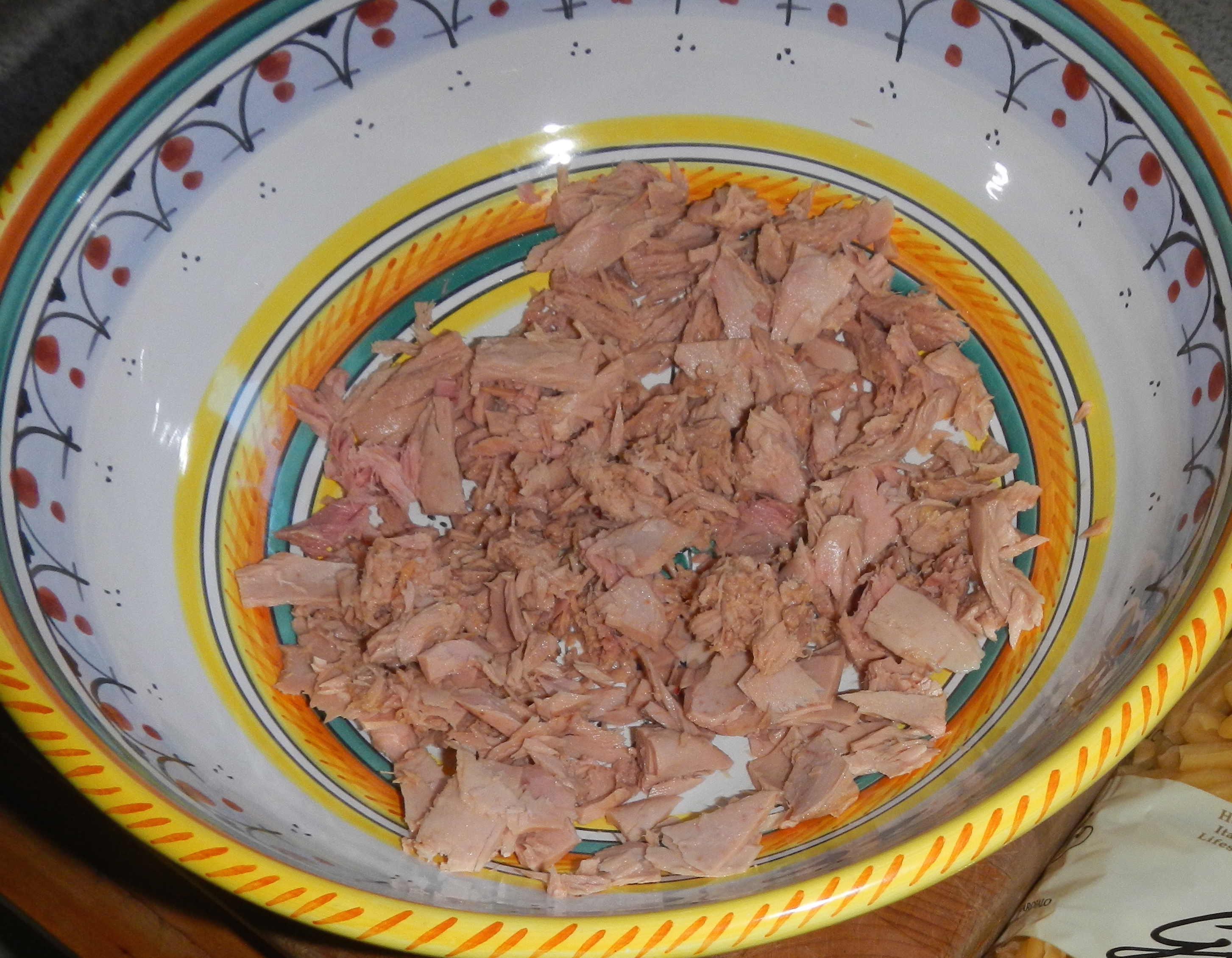
I must say, Costco’s skipjack tuna is a lot nicer looking than some of the mushy & unappealing supermarket brands I’ve used (can you hear me, Chicken of the Sea?!). Breaks up into firm, handsome flakes.
Because it’s not the season to be making fresh tomato sauce (unless I want to buy tomatoes from the southern hemisphere, which I most definitely do not), Kirkland Marinara Sauce, which is also new to me.
[Yes, I do a lot of my grocery shopping at Costco. For the low prices, naturally, but also because I can get good organic ingredients & a few well-made prepared foods there. I don’t normally use much prepared stuff, but face it, some things – like good-quality canned beans, marinara, frozen fish, canned tuna – are handy to have around for those days when you just don’t feel like cooking dinner 100% fresh-from-scratch. I’ll dive deeper into this topic in a later post.]
And for good measure, nonpareil capers, because… well, because I can’t follow a recipe to save my life. It’s boring. So for today, my take on Martha Rose Shulman’s Pasta with Tuna & Olives. Easy, delicious, & fast enough for a weeknight meal.
Pasta With Tuna, Capers & Dried Olives
(adapted from http://cooking.nytimes.com/recipes/1016459-pasta-with-tuna-and-olives)
Ingredients:
• 1 7-oz can chunk light skipjack tuna in water, drained
• 2 tablespoons nonpareil capers, drained
• 2 generous tablespoons extra virgin olive oil
• 2 cloves garlic, minced
• 2 c. marinara sauce
• 5 or 6 sprigs of fresh Italian parsley, minced
• 1/2 tsp. dried red pepper flakes (optional for Ms Shulman, not optional at my house)
• 1/2 c. Penna Olivasecca Dry Pitted Olives – I cut about half of them in half to distribute the flavor, & left the other half as whole dried olives for the decadent way whole olives look in a sauce.
• 12 oz. organic Italian pasta – use a shape that will catch & hold the sauce. I’m using organic penne from the bulk food department at Berkeley Bowl.
• Freshly grated Parmesan
Preparation:
1. Put a big pot of water on to boil for your pasta.
2. In a large pasta bowl (time to get out the Deruta pottery!), break up the tuna.
3. Heat olive oil in a small saucepan over medium heat; add garlic & cook until fragrant – like, 30 seconds to a minute at the very most. Add to the tuna along with the parsley & capers; stir to combine, & set aside.

4. Add marinara to the saucepan, heat through & season to taste – this Costco sauce didn’t need anything other than a twist of freshly-ground black pepper. Add red pepper flakes & olives, & simmer a couple of minutes to infuse the sauce with olive flavor & heat from the chiles. Set aside.
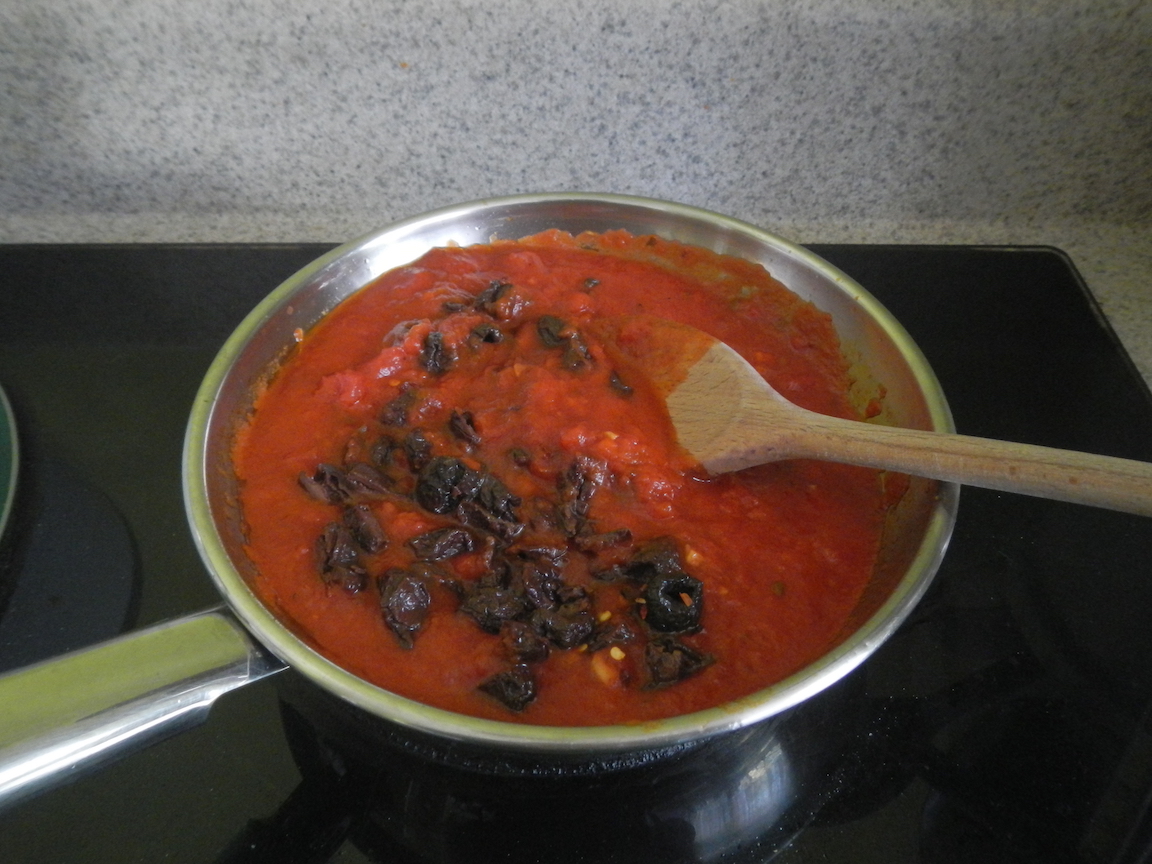
5. When the water is boiling, add a heaping tablespoon of salt & the pasta. Cook until al dente. Drain, reserving 2 or 3 tablespoons of pasta water. Add reserved water to tuna mixture & stir.
6. Transfer drained pasta to the bowl. Add tomato sauce, toss everything together & serve. Pass freshly grated Parmesan at the table.
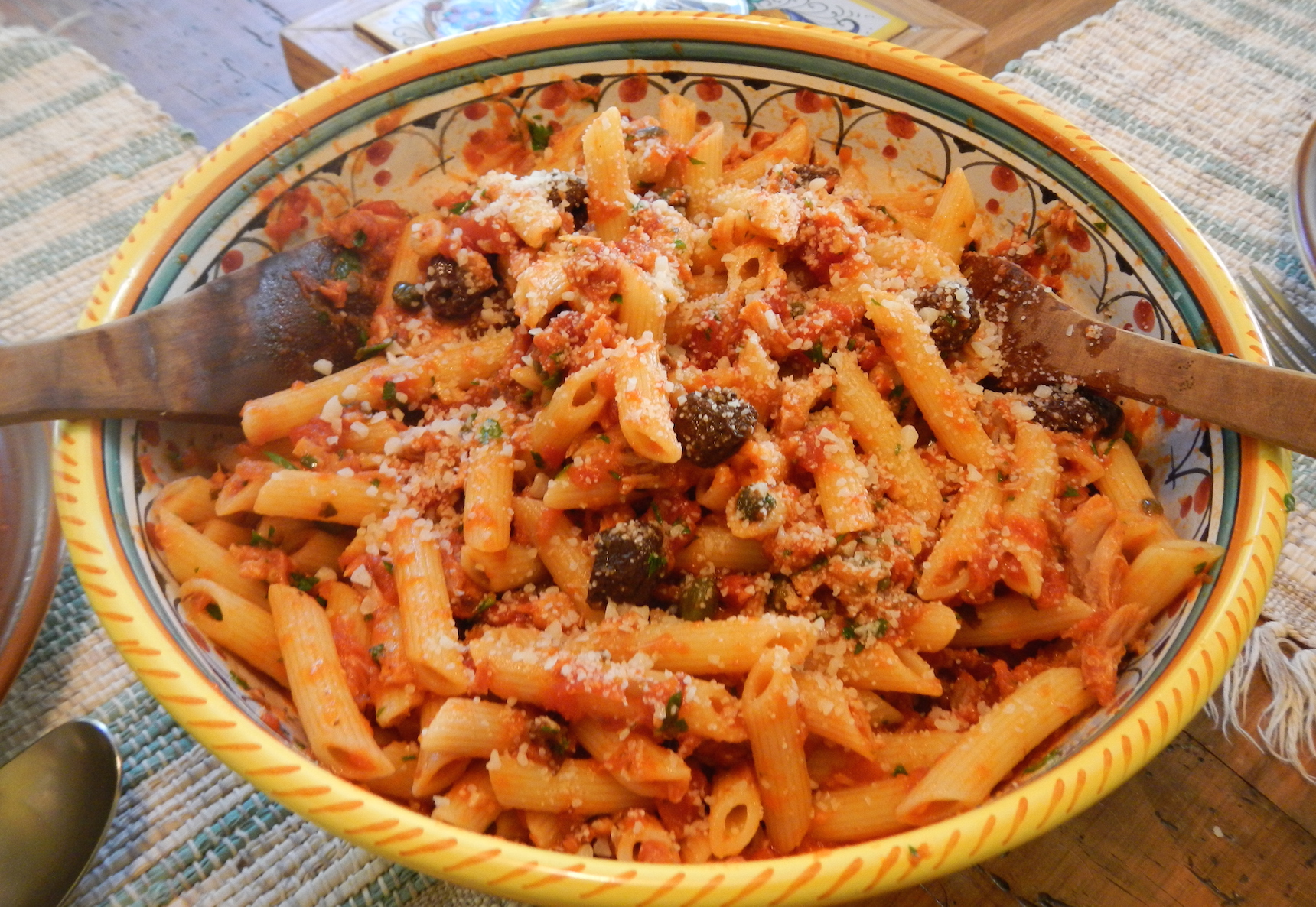
Yup. This one’s a keeper. The dried olives are also a keeper, a new pantry staple that I’ll be happy to keep on hand : https://www.greatolives.com/buy-gourmet-olives/index.php?route=product/product&path=44_59&product_id=52
Simple Pasta Sauce
As I said in my previous post, this was an easy way to do something productive with a 10-lb basket of tomatoes at the end of the season.

Fresh tomato sauce – this is from about 10 lb. tomatoes, mostly Romas & Early Girls

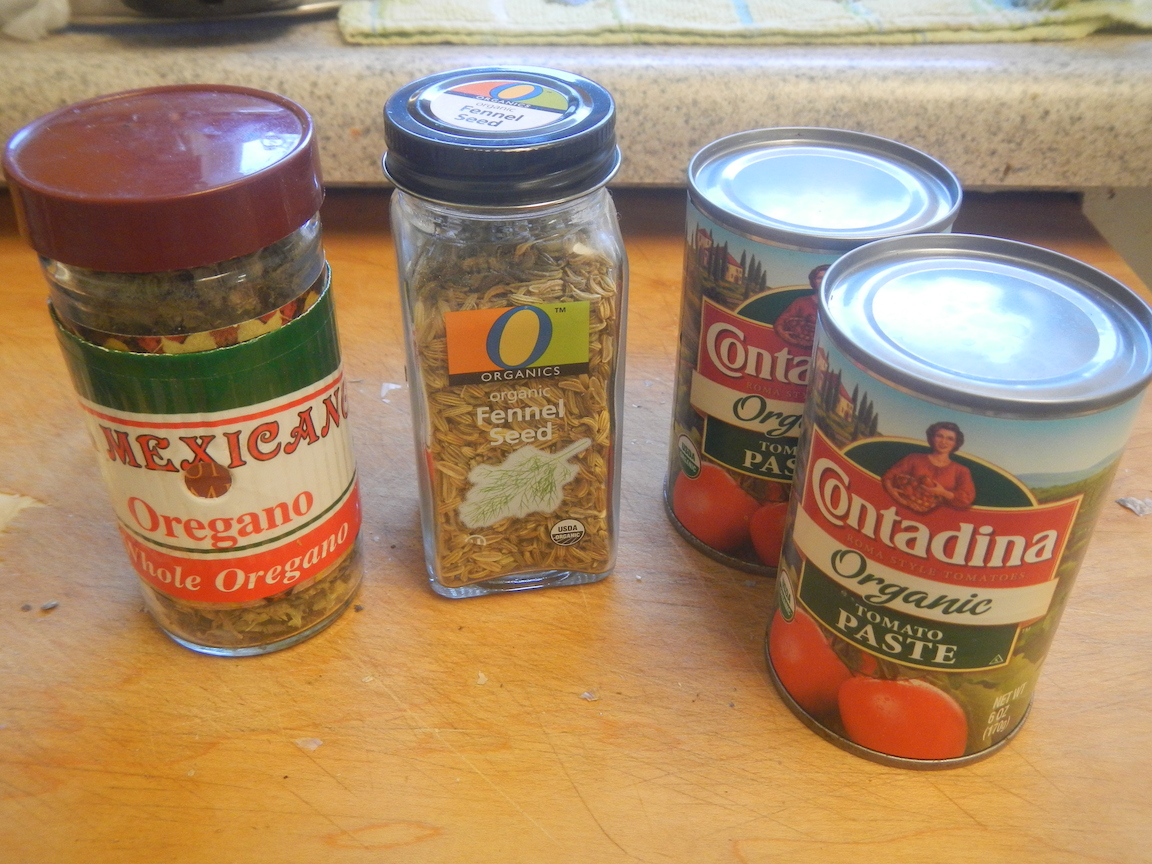

The add-ins: some of this summer’s crop of garlic, about a dozen heads of Italian Purple, a hardneck variety that I’m using mostly because the hardnecks don’t hold in the pantry as long as softneck varieties. It doesn’t hurt that it’s Italian. A couple of cans of tomato paste for a thicker sauce & a deeper flavor (I ended up using 3 cans); organic fennel seed; Mexican oregano, which I like because it comes as whole leaves & stems, all you need to do is crush it between your hands & pick out the twigs; & fresh Italian parsley from the herb garden. And sea salt to taste — in this batch, about 3 Tbsp.
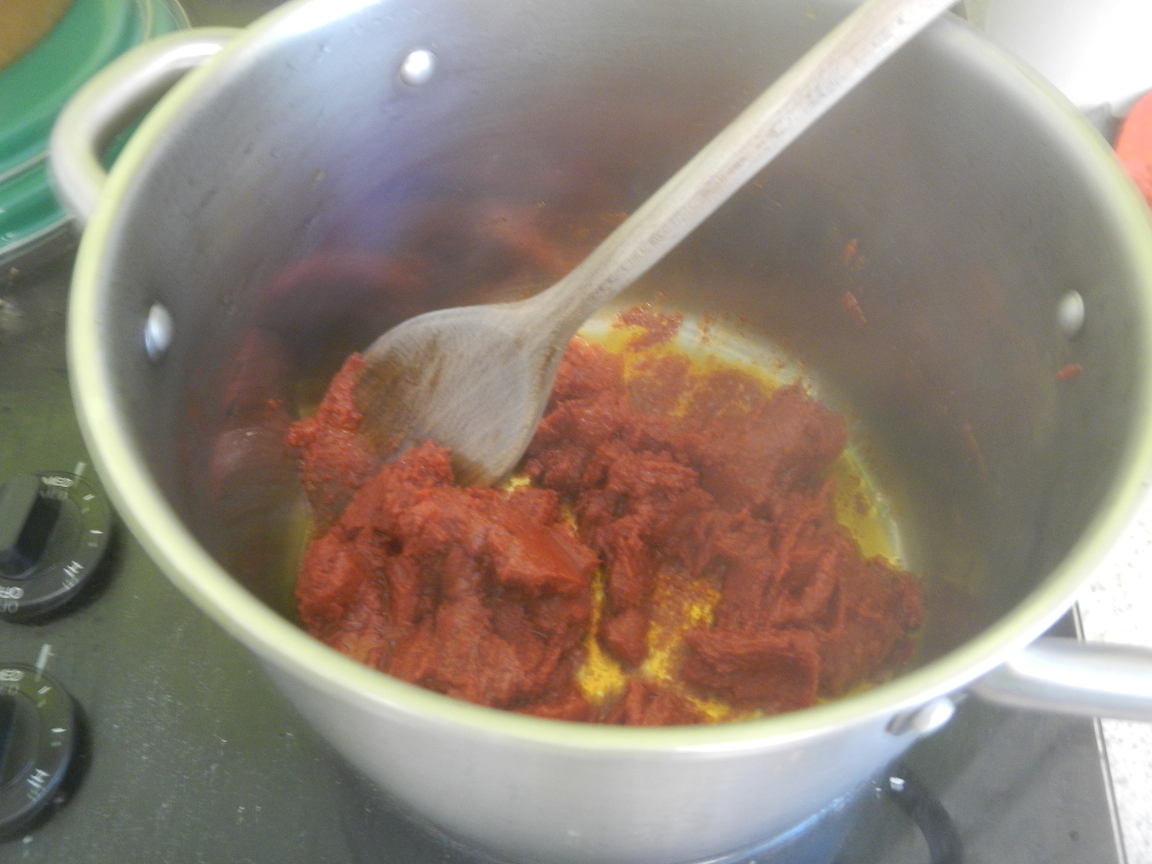
Sautéing the tomato paste in a little olive oil before I add the minced garlic.

Adding the raw tomato sauce, fennel, oregano & parsley; threw in a couple of bay leaves too. Simmer for maybe half an hour until I like the flavor enough to call it done. Once finished, a splash of red wine vinegar to rev up the tanginess &, incidentally, acidify it for canning. Then pack into hot, clean pint-&-a-half jars & into a pressure canner for 10 minutes. I use the National Center for Home Food Preservation’s guidelines (http://nchfp.uga.edu/index.html) as my go-to online reference.
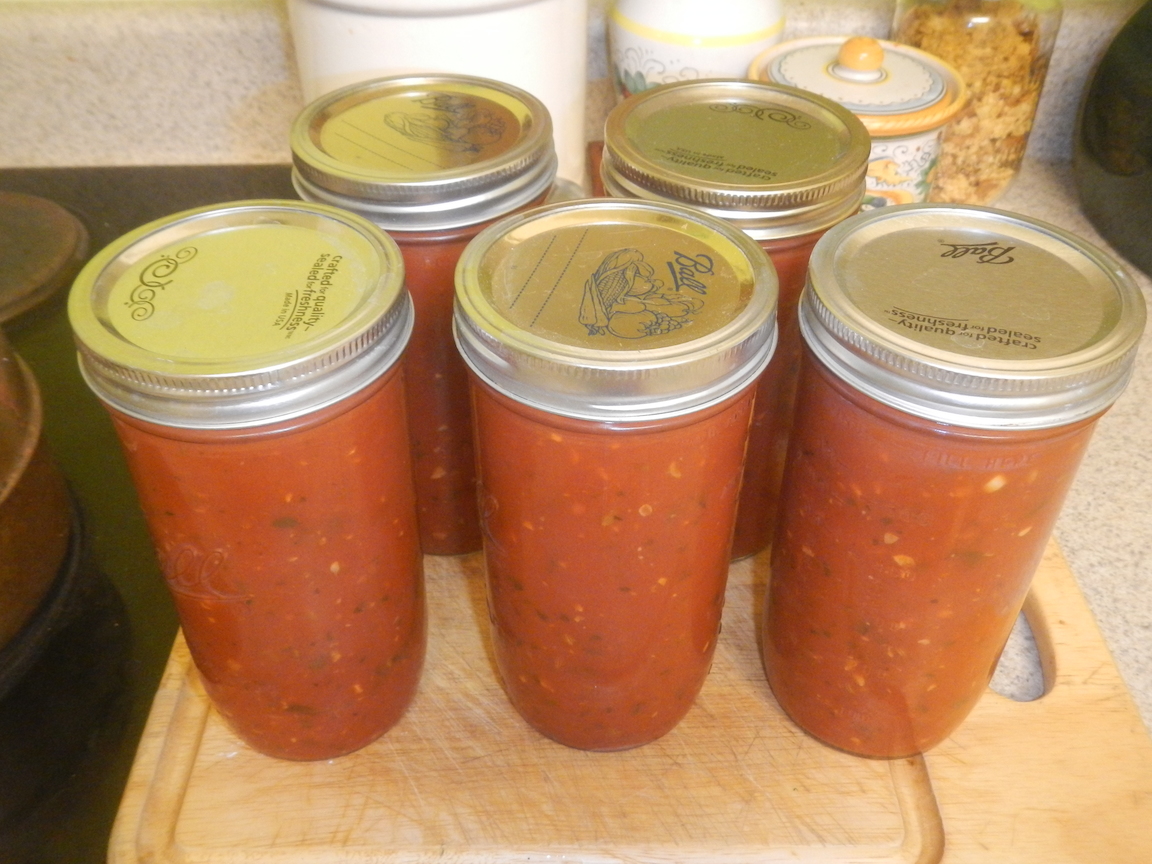
Done!
Playing with food
Really, that’s what I do. My big old-fashioned farmhouse kitchen is a place to play.
Before my husband (“the Hubster”) & I moved into my family home in Marin, we spent more years than I care to think about living in a townhouse in the East Bay. And I, at least, hated almost every minute of it. Not just the neighborhood on the edge of a ghetto, though that was reason enough for any sensible person to hate it; but OMFG, the kitchen! Less than half the size of what I have now, functionally less when you consider it was an eat-in kitchen; with a sink wide & deep enough to bathe a Golden Retriever in & about 3 feet of counter space. Outside the kitchen door, a yard with horrible clay instead of good healthy loam, that in any case was too small to hold more than a couple of flowerpots.
For someone who loves to cook, & who grew up eating home-grown, home-preserved produce, it was sheer hell. Three years ago we moved back to Marin, with all the headaches & snafus that come with a move plus a few extra ones thrown in for good measure. As we stood in our disorderly new kitchen & looked out at the neglected vegetable-garden-that-was, the Hubster asked me how I felt. All I could do was smile at him through tears & say, “Honey, I haven’t been this happy in years.”
So, here I am. Relaxing a bit after a summer of vegetable growing, fruit picking, canning, jam-making & experimenting (about which more next year, when I’m in the thick of it again).
Today’s task is dealing with the last of the tomatoes, picked just before the first rain of autumn. I grew four varieties this year, two plants each of Early Girl & Roma, one each of Sweet 100 & Gardener’s Delight. Most of the cherry tomatoes end up in salads, the Hubster’s lunchbox or the dehydrator; the full-size fruits end up in my canning jars. But what I’ve just picked isn’t enough to bother canning as whole pack, so I’ve run them through a “Roma” brand food strainer & will be making a Simple Pasta Sauce to can for this winter.
So what’s the big deal anyway?
“You’re from Marin? Ohhhhh.” [Subtext: that explains a lot.]
No, it doesn’t, damn it!
I didn’t think of Marin as anything special when I was a kid. It was just home, you know? Where I lived, & played, & went to school.
After my parents were married in 1935 they settled in Marin, primarily because my father already lived & worked here. Dad was born in Merced in the San Joaquin Valley, but was moved into St. Vincent’s School for Boys, a few miles north of San Rafael, when he was a boy. St. Vincent’s is run by the charitable arm of the Archdiocese of San Francisco, & these days is a residential treatment facility for seriously disturbed boys; but in the 1920s it was more like an orphanage/boarding school. Dad & his brothers weren’t orphans; but their mother was dead, their father couldn’t care for them & work to support them at the same time, so they were sent to live and be educated at St. Vincent’s.
Mom was born in San Jose; she, too, had an untraditional home life. Her parents were divorced when she was very young, & she & her three siblings were divvied up amongst the relatives. Mom went to live with her maternal grandparents; her little sister Evelyn went to her paternal grandparents; her brothers Bill & Harry went to St. Vincent’s. It was when Mom went to visit them there that she first met my father.
After Mom & Dad were married they lived in & around central Marin; out in Fairfax for a while, then way out in Santa Venetia, long before it was developed; eventually built a tiny house on a new street adjoining the farmland north of San Rafael. After they started a family they built a bigger house a few hundred feet farther up the street. It was set in the middle of two lots, with garden all around it: flowers & decorative plantings in the smaller front yard; fruit & nut trees, grape arbor & a huge vegetable garden in back, big enough to supply most of the produce needed to feed a family of eight, all year round. [We called it ‘the back 40.’] This is the house I grew up in, & still occupy.
So where was I? oh yes, Marin, in italics. It is indeed a special place, very beautiful, with redwood forests, farmland, dairies, creeks & hills & beaches, & our spirit guardian Mount Tamalpais looming over the entire county; but there was no particular mystique about it. But then one of the large format magazines (Life or Look or somebody) published an article extolling the sunny, relaxed, marijuana-laced hedonism of life in Marin. Huh? My family all read & enjoyed it mightily; especially hilarious was the author’s statement about our weather: “It’s always May 8th in Marin County.” We got a lot of mileage out of that, because spring in Marin is just about as unpredictable a time, weather-wise, as you can find. But as for the rest of it, whoever wrote the article had evidently talked to a bunch of people the like of which none of us had ever met.
Dad co-owned a garage in San Rafael & was an automotive mechanic by trade, until he sold his share of the garage & went back to St. Vincent’s to work as their facilities manager (& farmhand, when occasion demanded); Mom was a housewife, a job that during her marriage included seamstress to one husband & six rapidly-growing kids, Victory gardener, home food preservation specialist & financial manager, among other things. I went to school with children from more affluent families, but none of my schoolmates’ parents did anything to get snobby about, nor were they conspicuous consumers of anything (at least as far as we knew!). We lived in normal middle-class families too, though one family down the block was regarded as slightly louche because they drove a Citröen. And pot? what’s that?
One of the beautiful things about the neighborhood I call home is that it is still resolutely middle class; older, smaller houses, on larger lots than you see in modern subdivisions, positioned such that they aren’t rubbing elbows with the houses on either side. [Interestingly enough, county zoning designates my neighborhood as Residential Agriculture.] You can still have a decent yard here; a vegetable garden; & a bit of privacy too, unlike those living in new McMansions on tiny lots who are literally looking into each other’s windows. And my neighbors are tradespeople; teachers; gardeners; truck drivers; yes, even a few housewives.
If living in Marin means being a hedonist, then I suppose that’s what we are. We have chosen to live here, after all. But for us, it’s home, pure & simple.
About that username…

…Username v. 1.0 was my name. How predictable. And, frankly, how imprudent in this Internet day & age.
What can I cook up that says something about me, that is more abstract & obscure (though not to my immediate family) than ordinary?
Something about being my mother’s daughter — something I wouldn’t have liked to admit thirty years ago, something with which, now, I’m completely at peace.
My mother, christened Margaret, was ‘Mugsy’ to my uncle Bill: her closest sibling in age, a childhood rival in everything, & a man who went through life with a wicked twinkle in his eye.
[Mom certainly lived up to the tag. She used to tell a story about the time Bill threw her favorite doll down the outhouse. Her response? She clocked him one with a hammer. He wore the scar on his forehead to the end of his days.]
And dotter? Swedish for ‘daughter’. No, we’re not Swedish; but I’ve been to Stockholm, liked it very much & would love to spend more time in Sweden. I chose dotter as a suffix in the spirit of Scandinavian surnames à la Kristin Lavransdatter.
So, there you have it: Mugsy’s daughter. That’s me!
Introducing… me
… me being a woman of a certain age, born & raised & living in Marin County, California.
And what prompted me to join the thousands of other bloggers on the Web? I don’t want to say, sheer irritation, but that’s kind of what started it. Irritation with the widespread perception of Marinites as wealthy beyond everyday dreams of wealth; entitled, arrogant, snobbish; conspicuous consumers of everything under the sun. Like every cliché, it’s based on a certain set of facts, but it doesn’t reflect nearly all the facts. The facts being that, despite Marin’s undisputed status as one of the 25 wealthiest counties in the United States, there is a substantial population of real people living a real life, people like me: middle class, working class, whatever you want to call us.
We don’t drive Lamborghinis, Teslas, or even BMWs; our mortgages, if we are still paying one down, are a comfortably low percentage of our take-home pay; our yearly property taxes are nowhere near five figures, let alone six. And we don’t share our space with a housekeeper, personal chef, au pair or even a daily.
We have chickens in the back yard &/or suburban organic farms; we hang our laundry out to dry when there’s sunshine enough, & reluctantly use the dryer when there isn’t; we have a pantry stocked with the fruits (and vegetables) of our labor; we cook our own food, wash our own dishes & maintain our own houses.
We are, if you will, grounded in Marin. And, despite all the misleading national press, proud to say we’re Marin natives. Because we know that the down-to-earth life in Marin — the El Dorado of northern California — is alive & thriving.
This blog is a window into one small piece of real Marin. Welcome.
 grounded in Marin